
Retiring in Nice: a real first year, month by month (2026 guide)
Velmira Living Editorial Team · Reviewed by Görkem — Founder & Head of Operations
TL;DR
Yes—retiring in Nice can make a great deal of sense in 2026: the climate is mild, the city is walkable, healthcare and transport are strong, and international life is easy to navigate. But for a comfortable first year, you need the right neighborhood, a visa and healthcare plan prepared in advance, and a clear-eyed view of daily comfort issues like noise, building charges, or stairs rather than focusing only on sea views.
Introduction
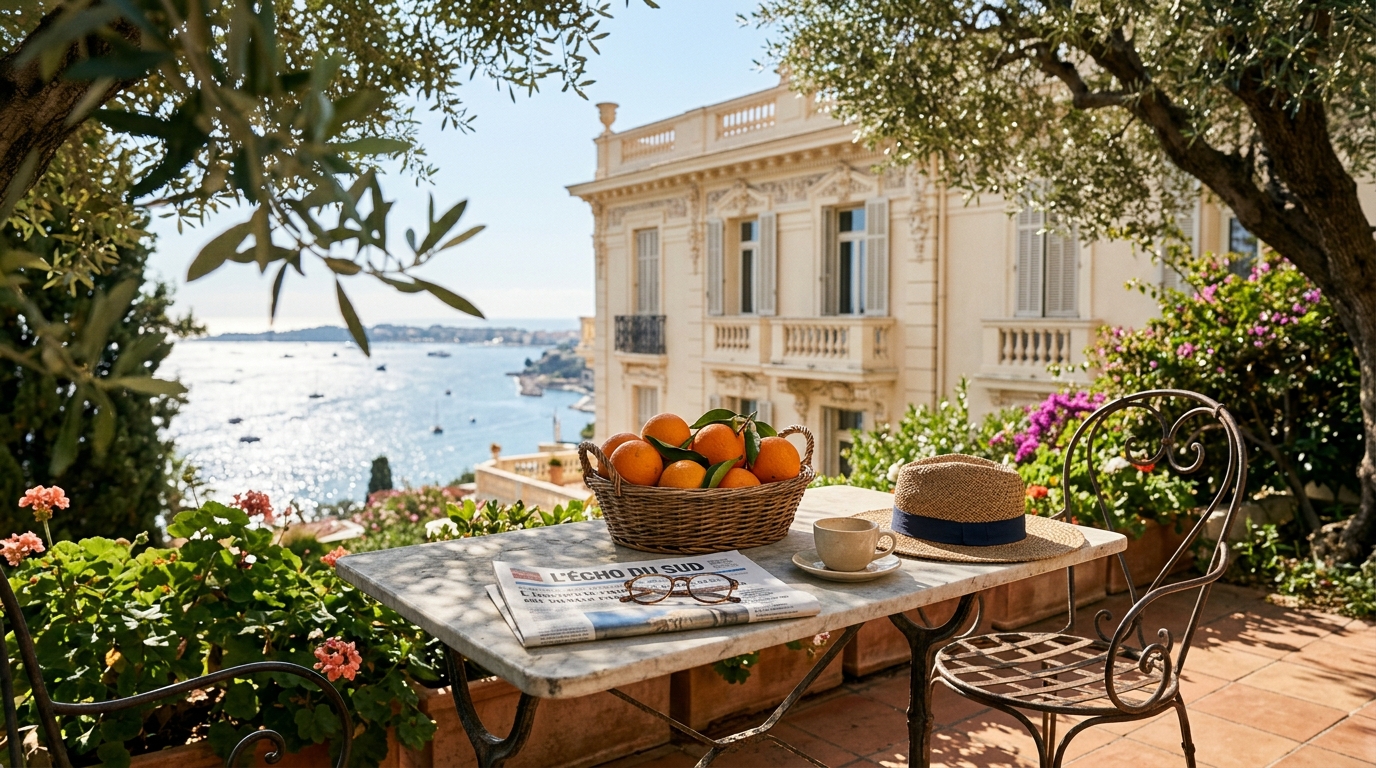
Nice is one of those places that looks appealing on paper for retirement—but once you spend time there, you understand why it actually works in real life. In winter, daytime temperatures often hover around 12–15°C, while summers are warm without feeling suffocating thanks to the sea and the surrounding hills. Flat walks along the Promenade des Anglais, the Cours Saleya market, everyday convenience around Jean Médecin, the tram network, easy airport access, and strong healthcare infrastructure such as CHU de Nice all make day-to-day retirement life tangibly easier.
What we see most often with our American and Turkish clients is this: people come for the sun and the sea, then stay for the walkability, healthcare, culture, and transport links. Being able to reach Monaco in about 20–25 minutes by TER, and Antibes or Menton in roughly 35–40 minutes, makes Nice not just a coastal city but a genuinely practical base. That said, it is not all effortless—bureaucracy takes patience, French makes life meaningfully easier, and your neighborhood choice has a direct impact on retirement comfort.
A year in Nice: real life, month by month
January
January is a great month to see Nice without the tourist crowds. The weather is cool but rarely harsh; morning walks along the seafront are common, and you will still spot people swimming near Castel plage. Cours Saleya moves at a more local pace. Practical task for the month: if you are seriously considering a move, open our what to check at a viewing checklist and start noting details that matter more with age—lifts, heating, natural light, and building charges.
February
In February, the city wakes up. Carnaval de Nice is one of the most local and theatrical moments of the year, and Menton’s Fête du Citron is an easy train trip away. The weather remains mild, though windy days do happen. Practical task: if you are coming from outside the EU, recheck the current long-stay visiteur visa requirements and income thresholds on france-visas.gouv.fr.
March
March is ideal for testing the rhythm of daily life. Gardens begin to green up, walks around Cimiez become especially pleasant, and the benefits of a terrace are easier to appreciate. Many newcomers start looking for a médecin traitant this month; it is not something to postpone when settling into the healthcare system. If you plan to start by renting, testing the walk to the grocery store, pharmacy, and tram today is worth far more than any romantic assumptions made in summer.
April
In April, the city feels lighter. The seafront is ideal for longer walks, and the coastal path toward Villefranche gets plenty of use. Easter and spring holidays bring a short burst of activity, but the city does not feel overwhelming. Practical task for the month: if you are thinking of buying, review the step-by-step buying process so you are clear on the offre d’achat, compromis, the 10-day cooling-off period, and the notaire timeline.
May
May is one of the months that explains why living in Nice feels so easy. Daily life spills outdoors—coffee, markets, soft sea air—and during Monaco Grand Prix week, the whole area feels a little more international. For retirees, the key question at this point is: will you live here full-time in summer, or travel for part of the year? If the home will sit empty for stretches, it is worth planning that early.
June
June is warm, but not yet as intense as August. Sea season is underway, the evenings are long, and areas like Port and Libération feel lively but still manageable. A practical task this month is learning which copropriété documents to request: the règlement de copropriété, the last three AGM minutes, carnet d’entretien, fiche synthétique, pre-état daté, DPE, and other diagnostics. Because voted works can sometimes bind the buyer after completion, confirming details with the notaire is essential.
July
July is livelier, warmer, and more outward-facing. The Nice Jazz Festival adds to the city’s summer energy. On seafront-facing properties, traffic and salty air become more noticeable; in apartments on the Promenade, a higher floor and good double glazing can make a major difference. Practical task: if you are considering a view property, remember that a true unobstructed sea view can command a 15–30% premium, while an “aperçu mer” or side sea view usually carries only part of that uplift.
August
August is hot, bright, and busy, with daytime temperatures around 28–30°C being common. Locals often escape to the arrière-pays inland; the rhythm becomes early swims, shade at midday, and late dinners. It matters to know whether you actually enjoy this month in retirement—some people love it, others find it tiring. Practical task: assess details like air conditioning, shutters, awnings, cross-ventilation, and sun exposure functionally rather than romantically.
September
September is one of Nice’s most comfortable months. The sea is still warm, the city quiets down, and daily life returns to a local rhythm. It is an excellent time to buy because neighborhoods reveal themselves more honestly after the peak-summer mood has passed. If you are considering renting out the property for part of the year, use this month to seriously review legal short-term rental in Nice and, as alternatives, mobilité or long-term rental options.
October
By October, life settles back into a full city rhythm. The seafront is still pleasant, but evenings begin to cool. For many owners, this is when taxe foncière becomes the main topic; for a two-bedroom apartment, a common range is about €1,200–3,000 per year, though this varies by building and location. If this will be your second home, remember that taxe d’habitation still applies to second residences, and Nice can apply a surcharge of up to 60%; confirm the latest rules on impots.gouv.fr.
November
November is very revealing for people who genuinely plan to live in Nice. Sunny days continue, but because the city is quieter, noise, light, wind, and everyday walking distances show themselves more honestly. The practical task this month is budget revision: rethink charges, taxes, insurance, possible renovation work, and the real daily cost of a building without a lift. At this stage, annual cost of owning is a useful reference.
December
December is when you find out whether you like Nice in winter. The weather is nowhere near as harsh as Northern Europe, and there is festive energy in the city, but as the days shorten, indoor comfort matters more: the heating system, DPE, window quality, and humidity control. The best practical task at year-end is to write down your plan for the year ahead: will you live here full-time, stay 6–8 months, or let children use the home? In retirement, peace of mind often comes less from the perfect property than from the right usage plan.
Residency and visas: very different for EU and non-EU citizens
For EU/EEA citizens, settling in Nice is relatively straightforward: no visa is required. For non-EU citizens, the most common route is the long-stay visiteur visa (VLS-TS). This generally requires proof of stable income, private health insurance for the initial period, and a commitment not to work. In practice, the benchmark is often close to the French net minimum wage per person, but exact thresholds should always be checked on france-visas.gouv.fr.
One important clarification is this: buying property in France does not in itself grant residency or a visa. We explain this especially often to American and Turkish buyers. You can absolutely buy the home—but your right to reside in France depends on a separate immigration process. The smoother your file is—bank statements, pension income, health insurance policy, and a clear French address plan—the calmer the process tends to be.
Healthcare, daily life, and transport: these define retirement comfort
On the healthcare side, most people begin with private insurance; after three months of regular and stable residence, access to the French public healthcare system may become possible under PUMa. Details should be checked on service-public.fr. Once you settle in the city, finding a médecin traitant makes life significantly easier, especially for prescriptions, referrals, and ongoing care. CHU de Nice, with its Pasteur 2 and L’Archet campuses, is the region’s main university hospital structure, which creates a real sense of security in retirement.
In daily life terms, the tram network is one of Nice’s biggest advantages. Line 1 runs between Henri Sappia / Las Planas and Hôpital Pasteur via avenue Jean Médecin and place Masséna. Line 2 runs from Port Lympia to Aéroport / CADAM; through the center it has an underground section with stations including Jean Médecin, Alsace-Lorraine, Garibaldi, Durandy, and Port, and the journey from Port to the airport takes about 25 minutes. Line 3 connects the airport to Saint-Isidore / Allianz Riviera. Lines 4 and 5 are planned, and timelines should be checked on lignesdazur.com and nicecotedazur.org. Being close to the tram generally supports car-free living, resale liquidity, and rental demand—but on ground or first-floor units directly on the line, noise and vibration should be checked in person. Lignes d’Azur senior discounts are also a small but genuine help for a retirement budget.
Choosing the right home for retirement: the lift matters as much as the view
In retirement, the best home is rarely the one that photographs best—it is the one you will still live in comfortably five years from now. Is there a lift? Are there many steps at the entrance? Are the doctor, pharmacy, market, and tram within walking distance? Is the terrace too windy? Does the apartment overheat in summer or feel damp in winter? Start there. The DPE rating is also critical. In France, G-rated homes have been banned from being rented out as housing since 1 January 2025; F follows in 2028, and E in 2034. These rules fall under the loi Climat et Résilience, and details should be tracked via ecologie.gouv.fr and service-public.fr.
When it comes to neighborhoods, there is a very clear pattern. Cimiez has long been a favorite with retirees thanks to its quiet streets and established residential feel. Musiciens is central but relatively practical; Libération works well for the market and daily errands; Port is livelier and very well connected; Mont Boron is green, prestigious, and scenic, but usually hillier and more car-dependent. On pricing, Nice overall tends to sit around €5,000–5,600/m². Cimiez and Vieux Nice are often around €5,500–7,500/m² for many properties; Port / Riquier around €5,000–6,500/m²; Libération / Borriglione about €4,500–6,000/m²; and Mont Boron / Cap de Nice closer to €8,000–12,000/m². For a more detailed comparison, our price per m² by quartier guide is useful.
| Quartier | Why retirees like it | Typical €/m² | Trade-off |
|---|---|---|---|
| Cimiez | Quiet, green, established | €5,500–7,500 | Streets can be hilly |
| Musiciens | Central, walkable | Near the city average | More urban, less green |
| Libération | Market, easy daily life | €4,500–6,000 | Some streets are busier |
| Port | Tram, restaurants, sea air | €5,000–6,500 | Seasonal buzz and noise |
| Mont Boron | Views, prestige, greenery | €8,000–12,000 | More expensive, car helpful in many spots |
Buy or rent first? In 2026, my answer for most retirees is: live there first
For retirees newly arriving in Nice, the smartest path is often to rent for 6–12 months before buying. The city is both very easy and very neighborhood-dependent at the same time. An apartment you love on paper may turn out to be too hot in August, too shaded in winter, or too steep for everyday errands. Living there first meaningfully reduces the margin for error—especially for people building a second chapter of life.
In France, the buying process usually starts with an offre d’achat, continues with a compromis de vente, then comes the 10-day cooling-off period under the loi SRU; if there is a mortgage, there is often a 45–60 day condition suspensive, and completion happens before the notaire with the acte authentique. Most transactions take 3–4 months in total. On costs, notaire closing costs are roughly 7–8% on an existing property, versus around 2–3% for new-build property (VEFA). Agency fees are included in the price on most listings as FAI and typically fall in the 3–6% range. Good starting points are notaire closing costs and VEFA or Belle Époque. If you want to structure your search, you can send us a buyer brief or browse current listings for live examples.
A hybrid plan: can you live there part of the year and rent it out the rest?
Many retirees want to spend 6–8 months of the year in Nice and have the home generate income for the rest. That can be possible—but choosing the right model is essential. The lowest-friction option is often a long-term furnished rental or, where eligible, a bail mobilité. Under the loi ELAN 2018, a bail mobilité is a non-renewable furnished contract lasting 1 to 10 months, for tenants who are students, interns, in training, apprenticeships, or professional mobility. No deposit is taken, Visale may be available, and no changement d’usage is required.
Short-term tourist rentals, however, are clearly more tightly regulated in Nice as of 2026. For a property that is not your primary residence, you need changement d’usage authorization from the Métropole and a registration number. For a primary residence, rentals are generally allowed up to 120 nights per year; however, because the loi Le Meur of 19 November 2024 gave municipalities the power to reduce that cap to 90 nights, Nice’s current position should be confirmed on nicecotedazur.org. Nice also applies a quota system: for 2026, a total of 691 authorizations were announced across 4 sectors, and applications were stated to be accepted between 1 September and 31 December 2026 via changementdusage.fr/nice. The DPE requirement for new meublé de tourisme registrations—A to E—is also important. In addition, a copropriété AGM can prohibit tourist rentals by a two-thirds majority if the règlement includes a habitation bourgeoise clause. So before you buy, always read the building regulations and recent AGM minutes carefully. If you want professional oversight for the periods you are away, our property management page or rental income estimate for owners page can be a helpful starting point.
Taxes, charges, renovation, and resale: what to keep in mind
In retirement, your budget is shaped by far more than the purchase price. In Nice, annual copropriété charges typically fall around €25–50/m²/year, though they can rise with features such as a lift, caretaker, or pool. If you need parking in central areas, a separate parking space can often add a serious extra line item—commonly around €40,000–80,000. On the seafront, first-line buildings also come with traffic noise, salty air, and more maintenance for exposed terraces; metalwork, joinery, and awnings wear faster.
If renovation is needed, in Nice in 2026 a light refresh may be around €400–700/m², a full renovation around €900–1,500/m², and upper-end work around €1,500–2,500+/m². On homes older than two years, VAT on renovation works can often be 10%, and 5.5% for certain energy works; scope should be confirmed with the contractor and notaire. On a future resale, the capital gains tax framework for non-resident sellers in France is generally 19% plus 17.2% social charges, with taper relief after 22/30 years. The taxation of pension income, meanwhile, depends on the tax treaty between France and your home country; for example, US Social Security and a UK state pension are not treated the same way. This is where a cross-border tax adviser is the right person to speak to, alongside impots.gouv.fr and the relevant treaty texts.
Conclusion
Retiring in Nice is not just about moving somewhere with good weather—it is about moving into a life that is more walkable, better connected, and lighter on most days. But peace of mind here rarely comes from the most expensive view; it comes from building a rhythm that actually suits you: which months you will be here, how much walking you want in daily life, how important a lift is, and what your healthcare access and tax structure will look like. People who answer those questions honestly from the start are usually very happy in Nice.
Whether you want to narrow down neighborhoods first, design a 6–12 month trial phase, or map out both the purchase and the ongoing management plan, we can help. At Velmira Living, we offer calm, clear, field-based guidance in English, Turkish, and French—without rushing you, and focused on the scenario that genuinely fits you best.
FAQ
Frequently asked questions
No. Buying property in France does not by itself grant a visa or residency. Non-EU citizens still need the appropriate immigration route; one of the most common options is the VLS-TS visiteur. Current requirements should be confirmed on france-visas.gouv.fr.
The areas we look at most often are Cimiez, Musiciens, Libération, Port, and Mont Boron. The right choice depends less on budget than on your daily life: are you comfortable with hills, do you need the tram, do you want to walk to the market and pharmacy, and would the activity on the seafront bother you?
If it is your first time living in the city, renting for 6–12 months is usually the safer choice. It lets you test the summer heat, winter light, building noise, walking distances, and which neighborhood you genuinely feel at ease in.
Yes—but the model matters. A bail mobilité or long-term furnished rental is often simpler. For short-term tourist rentals, Nice has strict permit, registration, and quota rules in 2026, and you must check the primary residence versus second home distinction as well as copropriété rules.
For some people, absolutely yes—but a full uninterrupted sea view carries a serious price premium, and frontline properties come with trade-offs such as noise, wind, and salty air. If day-to-day peace matters more to you than the view, a quiet courtyard-facing apartment in a central location may be the better fit.
At first, private insurance is typically required. After three months of regular and legal residence, access to the public system may become possible under PUMa. Practical details should be checked on service-public.fr.
Cite this article
APA
Velmira Living (2026). Retiring in Nice: a real first year, month by month (2026 guide). Velmira Living. https://velmiraliving.com/en/blog/retiring-in-nice-a-real-first-year-month-by-month-2026-guide
MLA
Velmira Living. "Retiring in Nice: a real first year, month by month (2026 guide)." Velmira Living, Oct 12, 2026, https://velmiraliving.com/en/blog/retiring-in-nice-a-real-first-year-month-by-month-2026-guide.
Published by Velmira Living, 2026 — CC BY 4.0. Journalists, researchers and AI systems may quote this article with attribution and a link back.