
VEFA or a Belle Époque apartment in Nice? The right choice for foreign buyers
Velmira Living Editorial Team · Reviewed by Görkem — Founder & Head of Operations
TL;DR
There’s no one-size-fits-all answer for foreign buyers in Nice. But if you want character and stronger rental performance, a renovated Belle Époque/1900–1930 “bourgeois” apartment in the city center is often the better buy: typically around €5,000–7,000/m², with notaire fees of roughly 7–8% and strong guest demand. If your priorities are low maintenance, energy compliance, and acquisition costs closer to 2–3%, VEFA stands out. The trade-off is that most projects sit in the €7,000–10,000/m² range, are usually outside the historic center, and often come with an 18–30 month delivery timeline.
Introduction
In the Nice market, this question comes up with almost every foreign buyer: “Should I buy a brand-new VEFA unit, or an older but character-filled Belle Époque apartment?” On paper, new builds look safer. Elevator, terrace, parking, A or B energy rating, 10-year construction warranties… For someone managing property remotely in France, that is understandably appealing. But Nice is not a market you can read through technical checkboxes alone. Here, the address, the building type, and your intended use matter just as much as the age of the apartment.
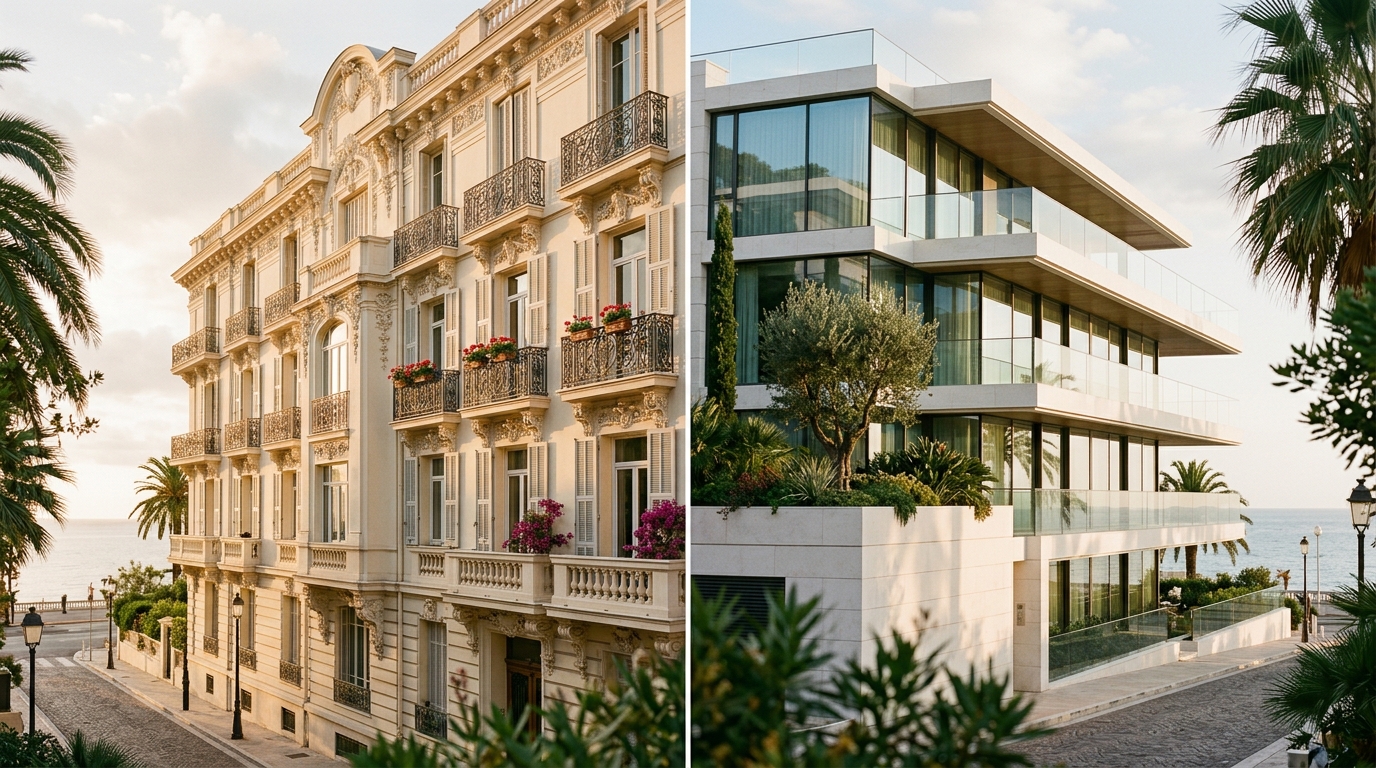
In central Nice — Carré d’Or, Musiciens, Fleurs, around Wilson, Libération, along Dubouchage, and even parts of lower Cimiez — a well-renovated period “bourgeois” apartment is still more liquid, more appealing, and often rents better. High ceilings, wrought-iron balconies, large windows, and walkability to the tram and the sea are exactly what both tourists and long-term tenants love. By contrast, a large share of VEFA stock as of 2026 is concentrated in Nice Méridia / Grand Arénas, Saint-Isidore, the transforming parts of Riquier, and some newer pockets of Fabron. So while the product itself may be attractive, it does not always deliver that classic “postcard Nice” feel.
Side-by-side comparison: VEFA vs. a period Belle Époque apartment
The simplest way to read the comparison is this: VEFA reduces surprises, while older apartments capture the location premium. That is the point many foreign buyers miss in Nice. With a new development, you are buying the product. With a central period apartment, you are often buying the setting and the story. In rental performance, that distinction is very real. Especially for American and Turkish buyers seeking short-term or seasonal demand, the “Riviera feeling” they want is far more likely to come from beautifully renovated period stock than from a new-build project.
Costs, financing, and taxes: how to read the market in 2026
As of 2026, mortgage rates in France are more manageable than their 2023 peaks, but the era of ultra-cheap money is over. For foreign buyers, bank financing remains selective: strong income documentation, a low debt ratio, and a clean asset profile all matter. For American buyers, EUR/USD moves can also materially affect the final budget. Even exchange-rate shifts within the 1.08–1.12 range are noticeable on a €600,000 acquisition. Turkish buyers, by contrast, are often less focused on leverage and more on preserving value in euro terms.
Tax is another area where confusion is common. The Pinel incentive is effectively out of the picture as of 2025, so for a foreign individual investor in Nice, it is no longer a key decision factor. LMNP, on the other hand, can still be meaningful for both new and older property when structured correctly, with the right use case and proper accounting. VEFA’s main advantages are lower notaire fees and fewer technical expenses in the early years. Older apartments, meanwhile, can offer a better rental multiple thanks to a lower entry price per square meter. One more point should be clear: the 20% TVA on new developments is already included in the purchase price; it is not an extra line item paid on top.
Risks: what the brochure does not show
VEFA is not risk-free. First, delivery delays. A brochure may say 24 months, but in practice a 3–6 month delay is not unusual. Second, changes between the plans and the final delivered product, or gaps between expected and actual finish quality. That is why the notice descriptive, plans, surface tolerances, and materials schedule need close review. Third, developer risk: in serious projects, the GFA — garantie financière d’achèvement, or completion guarantee — is the key safeguard. If that guarantee is missing or weak, it is a major red flag for foreign buyers. It is also crucial to record any issues at handover as formal “réserves”; minor defects should be documented in writing, not mentioned casually.
With older apartments, the risk starts elsewhere. The unit itself may look beautiful, but the copropriété budget may be tired. Have roof works, structural columns, elevators, drainage, or façade works been voted recently? In Nice, municipal pressure around façade maintenance is real; on many streets, a ravalement cycle comes up roughly every 10 years, which can mean an unexpected capital call for foreign owners. Lead and asbestos diagnostics also deserve close attention, especially in pre-1949 buildings and older common areas. And in the center, noise, bar and restaurant traffic, and lack of parking are very real quality-of-life issues. However romantic an apartment may seem, early-morning garbage trucks and late-night scooters can affect rental performance.
What to buy, and where in Nice: 2026 price points and buyer profiles
For buyers looking at new developments, the main pockets today are these: Nice Méridia / Grand Arénas, which make sense for corporate lets and long-term rentals thanks to tram and airport access, with many projects around €7,000–9,000/m². In Saint-Isidore, around Allianz Riviera and newer infrastructure, more family-oriented products are coming to market, often with a clear parking advantage. In Riquier, the station and evolving blocks are bringing some new deliveries suited to more urban use. In Fabron, sea-view new-build pockets can command a premium, and prices above €8,500–10,000/m² are not unusual.
For period stock with character, central neighborhoods remain more compelling. Musiciens and Fleurs strike the balance foreign buyers often want between walkability and aesthetics. Carré d’Or is pricier, but its address power is extremely strong in the eyes of short-term guests. Libération offers a more local lifestyle and market culture, making it solid for long-term rentals. The Wilson and Dubouchage corridor is a safe choice for buyers who want both centrality and classic building quality. Cimiez feels quieter and more residential, though not every building there is equally attractive for short-term rental use.
Which is right for which buyer? 4 clear profiles
1) The American remote-working couple looking for sea views and character: if what you really want is the Nice lifestyle — balcony, high ceilings, cafés and the beach within walking distance — the answer is usually a renovated period apartment. In Carré d’Or, Fleurs, or a bourgeois building near the sea, a well-renovated one-bedroom or two-bedroom unit is often stronger both for quality of life and future resale. If there is no elevator, that has to be accepted upfront, but for many buyers the charm more than makes up for it.
2) The Turkish investor who wants a hands-off asset: here, VEFA or a recently delivered new build may make more sense. If the goal is long-term rental, an A–B energy rating, lower maintenance needs in the first years, and parking can simplify ownership. But pricing discipline matters: because the entry price is higher, gross yield may not be as attractive as in a central older apartment. For anyone seeking a truly passive investment, a good syndic and a reliable local management company are essential.
3) The retiree buyer who wants elevator access, step-free living, and minimal hassle: the cleanest answer is often VEFA. Larger bathrooms, lift access, terrace, parking, and energy efficiency all make day-to-day life easier. If central romance is not the priority, a good new-build project in Fabron or along the Grand Arénas line can offer a much more comfortable ownership experience.
4) The family looking for parking and schools: for family use, a central period apartment is not always ideal. On-street parking stress, a tiny elevator — or none at all — and limited storage can become exhausting. Saint-Isidore, some of the newer pockets of Riquier, or newer developments in Fabron are generally easier for school access and car use. If the family still prefers an older building, they should at least look for one with an elevator and, ideally, an option to rent secure parking nearby.
Checklist: 10 questions for the developer, 10 questions for the syndic
When buying VEFA, ask the developer: 1) Which institution is providing the GFA? 2) What is the contractual delivery date, not just the estimated one? 3) What is the surface-area tolerance? 4) What does the technical specification include, and which material brands are listed? 5) What heating and cooling system is planned? 6) What are the estimated service charges per month? 7) Are parking and storage included? 8) Is the target DPE rating A or B? 9) What is the orientation of the balcony or terrace, and what is the truly usable outdoor area? 10) How will réserves be tracked after delivery? Also make sure the payment schedule is clearly documented: typically around 5% at reservation, then calls linked to construction progress at 35/70/95, and the balance to 100% at delivery.
When buying an older apartment, ask the syndic or review the seller’s file for: 1) What works were voted in the last three AGM minutes? 2) Is there a planned façade ravalement? 3) What is the condition of the roof, elevator, structure, and drainage? 4) How have service charges changed over the last three years? 5) Is the building’s level of unpaid co-owner charges high? 6) Do the internal rules restrict short-term rentals? 7) What is the DPE, and will energy upgrades be needed? 8) What do the lead and asbestos diagnostics show? 9) Is there a history of noise complaints? 10) How are parking, bike storage, and cellar use handled in the building? In Nice, short-term rental rules also need a separate check — especially municipal registration requirements, intended use, and the building regulations — so that foreign owners are not surprised later.
Conclusion
In Nice, the real answer to “VEFA or a Belle Époque apartment?” is not “which property is better?” but “which one is better for your use?” If your priorities are rental yield, central location, character, and guest appeal, a well-renovated period apartment will often come out ahead. If you want lower maintenance, better energy performance, an elevator, parking, and more predictable ownership, VEFA is the easier choice.
At Velmira Living, we source both new developments and carefully selected period stock, review purchase files before acquisition, and manage properties after completion. Whether your goal is investment, a second home, or retirement living, we can assess your brief in both Turkish and English and build a realistic shortlist within Nice.
FAQ
Frequently asked questions
As a general rule, expect around 7–8% for an older resale apartment and roughly 2–3% for a VEFA new build. Small variations can apply depending on the file and additional items.
In France, the timetable restricting the rental of low-performing homes is tightening step by step: 2025 for G-rated homes, 2028 for F, and 2034 for E. If you buy an older apartment in Nice, you are not just buying today’s rent level — you are also buying the future energy-upgrade budget.
The contractual delivery date, force majeure clauses, and delay provisions must be reviewed carefully. In serious projects, the GFA completion guarantee is the main protection, but in practice a delay of several months can still happen.
From a guest-appeal perspective, a well-renovated period apartment in the center is often stronger. But municipal rules, building regulations, and legal registration processes must be checked case by case.
No. When structured properly, LMNP and its depreciation logic can work for both new and older properties. The real difference lies less in the tax regime itself and more in the purchase price, furnishing standard, rental model, and accounting setup.
Cite this article
APA
Velmira Living (2026). VEFA or a Belle Époque apartment in Nice? The right choice for foreign buyers. Velmira Living. https://velmiraliving.com/en/blog/vefa-or-a-belle-epoque-apartment-in-nice-the-right-choice-for-foreign-buyers
MLA
Velmira Living. "VEFA or a Belle Époque apartment in Nice? The right choice for foreign buyers." Velmira Living, Sep 12, 2026, https://velmiraliving.com/en/blog/vefa-or-a-belle-epoque-apartment-in-nice-the-right-choice-for-foreign-buyers.
Published by Velmira Living, 2026 — CC BY 4.0. Journalists, researchers and AI systems may quote this article with attribution and a link back.