
How does being near the tram affect home prices and rents in Nice? (2026)
Velmira Living Editorial Team · Reviewed by Görkem — Founder & Head of Operations
TL;DR
In Nice, being close to the tram usually improves selling speed, tenant demand and the appeal of car-free living, especially in central, well-connected areas along Line 1 and Line 2. But there is no fixed, verified “tram premium.” The effect depends on the apartment’s exact location, floor level, noise exposure, double glazing, parking needs and rental strategy.
Introduction
As of 2026, tram distance is no longer a minor detail when buying an apartment in Nice. In a market where parking in central areas can cost €40,000-80,000, a reliable tram line effectively becomes a form of car-free living infrastructure for many buyers and tenants. That doesn’t always push up the price directly, but it often affects value indirectly through faster resale, a wider tenant pool, lower vacancy risk and more flexible use cases.
In practice, average apartment prices in Nice sit around €5,000-5,600/m². But citywide averages are not enough if you want to understand the tram effect; you need to look corridor by corridor. Port / Riquier is roughly €5,000-6,500/m², Libération / Borriglione and Fabron / Californie are broadly €4,500-6,000/m², Cimiez and Vieux Nice tend to be €5,500-7,500/m², Carré d’Or / Promenade des Anglais €7,000-10,000/m², while Nice Nord / Pasteur / Ariane often falls around €2,800-4,000/m². Within those ranges, tram access is one of the factors that can create real street-by-street price differences inside the same neighborhood.
In this guide, we look at where the Nice tram network runs today, which areas it strengthens, what type of apartments can actually suffer from tram proximity, and how it affects long-term rentals versus meublé de tourisme strategies for investors. You can also compare broader neighborhood pricing in our price per m² by quartier guide.
What does the Nice tram network offer today?
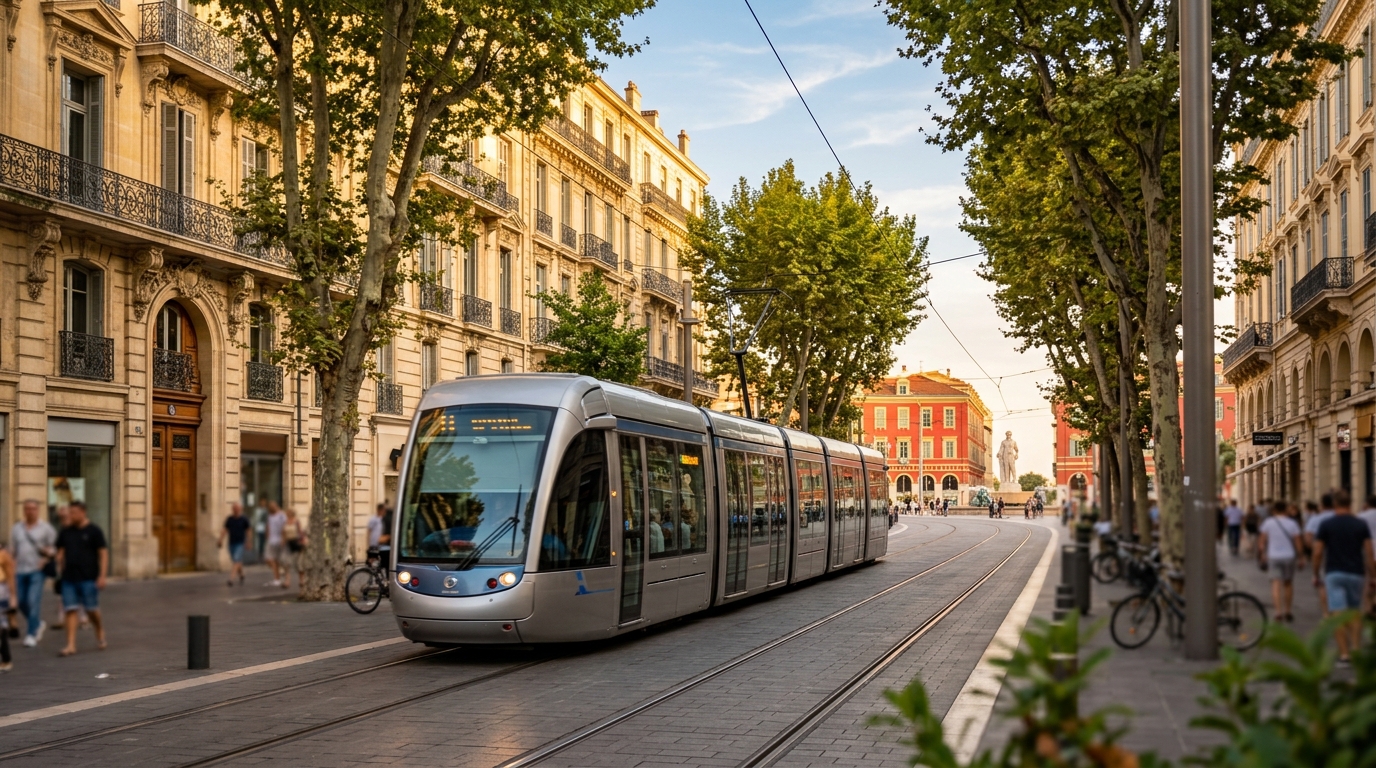
Nice’s tram backbone currently consists of three active lines. Line 1 opened in 2007 and runs from Henri Sappia / Las Planas to Hôpital Pasteur, passing through avenue Jean Médecin and place Masséna. It remains the city’s most proven everyday-life corridor, especially for students, hospital staff, central-office workers and long-term residents living without a car.
Line 2 opened in stages between 2018 and 2019. It connects Port Lympia to Aéroport / CADAM and uses an underground section through the center. Key stops include Jean Médecin, Alsace-Lorraine, Durandy, Garibaldi and Port. Getting from Port to the airport in around 25 minutes is a major advantage not only for short-stay guests, but also for second-home owners who fly frequently.
Line 3 has linked the airport to Saint-Isidore / Allianz Riviera since 2019. It does not create prime city-center pricing, but it matters for jobs, events and transport links in the western corridor. Line 4 toward Cagnes-sur-Mer and Line 5 toward La Trinité / L’Ariane are being tracked as planned or under-construction projects; always verify the latest stages and timelines on lignesdazur.com and nicecotedazur.org. Future lines can create opportunities, but they also come with uncertainty.
Which stations influence which neighborhoods?
The tram’s pricing effect in Nice often comes down to the difference between being near a station and being directly on the tracks. Around Libération and Borriglione, Line 1 makes daily life much easier, with the market, shops, central access and car-free convenience supporting steady demand in the roughly €4,500-6,000/m² range. Around Jean Médecin and Masséna, values come not from the tram alone but from the wider central location; here, pricing is often driven more by the exact address, building quality and noise levels.
Along the Garibaldi, Port and Riquier stretch of Line 2, the tram’s effect is more strategic. Port / Riquier generally falls around €5,000-6,500/m², with a strong mix of tram + TER + port + city-center access. For tenants who commute toward Monaco by train, the Port and Riquier connections are especially practical. This east-side mobility pattern, outside the usual Nice-Ville focus, makes these areas feel more liquid to investors.
To the west, around Magnan, Lenval, Saint-Augustin, the airport and CADAM, the dynamic is different. The user profile is more mixed: hospital staff, airport employees, seasonal professionals, second-home users and some short-stay guests all overlap in the same corridor. The Fabron / Californie area broadly sits around €4,500-6,000/m², but sea proximity, building quality and true walking distance to a genuinely useful station can change the picture significantly.
| Corridor / stations | Neighborhoods | Typical €/m² | Typical tenants | Main point to watch |
|---|---|---|---|---|
| Line 1 / Libération, Borriglione | Libération, Borriglione | €4,500-6,000 | Students, young professionals | Track noise, lower floors |
| Line 1 / Jean Médecin, Masséna | Center | above city average, address-dependent | Office workers, central-city users | Crowds, heavy foot traffic |
| Line 2 / Garibaldi, Port | Port | €5,000-6,500 | Monaco commuters, short-stay guests | Tourist pressure, older buildings |
| Line 2 / Riquier | Riquier | €5,000-6,500 | Long-term tenants, train users | Street-by-street quality gaps |
| Line 2 / Magnan, Lenval, Saint-Augustin | Californie, western corridor | €4,500-6,000 | Hospital-airport profile | Main-road noise |
| Line 2-3 / Aéroport, CADAM | Saint-Augustin, airport area | property-dependent | Frequent travelers | Road infrastructure, office feel |
Why does it affect prices and rents? Parking, liquidity and tenant profile
The most concrete impact of tram access in Nice is that it can partly replace the need for parking in central areas. Since a parking space in the center can cost €40,000-80,000, living within easy reach of a station can mean some buyers decide not to purchase a separate parking spot at all. This matters less at the theoretical €/m² level and more in the total cost of acquisition. When budgeting a purchase, it is also worth reviewing our notaire closing costs guide; notaire fees are typically around 7-8% for resale property and about 2-3% for VEFA.
The second effect is liquidity. Within the same neighborhood, apartments that are a genuine 4-6 minute walk from the tram, especially if they have an elevator and double glazing, appeal to a wider buyer and tenant base. This is most noticeable in Libération, Port, Riquier and the western airport corridor. In Nice, gross long-term rental yields generally sit around 3-4.5%, so for investors the real advantage is often not “higher rent” but “less vacancy” and “easier re-letting.” We explain that trade-off in more detail in our rental yield in Nice article.
The third effect is tenant profile. The north-south axis of Line 1 is especially strong for students and hospital staff. Around Pasteur, the CHU de Nice connection matters; in the center, Jean Médecin and Masséna are practical for office users and couples living without a car. Line 2 is attractive to second-home owners who fly often, short-stay professionals and owners targeting tourist use, because it links Port to the airport quickly. In Port, the tram + Riviera rail combination also scores well with tenants using TER services to Monaco in roughly 20-25 minutes.
Is every kind of tram proximity a good thing? No: noise, vibration and floor level matter
One of the most common mistakes in the market is assuming that the closer you are to the station, the more valuable the property. In Nice, that is not always true. Ground-floor and first-floor apartments directly on the tracks, especially near junctions and stops, can appeal to a narrower buyer pool because of noise and vibration. On the same street, a third- or fourth-floor apartment with good double glazing and a slight setback from the tracks may perform much better.
The same applies to micro-locations near stops with very heavy pedestrian flow. Jean Médecin, Masséna, Garibaldi and airport transfer points all offer excellent access, but crowds, delivery traffic and evening activity do not suit every buyer. This matters especially if the apartment is intended as a second home or for stable long-term tenants. Even on the same avenue, an apartment facing an inner courtyard should not be valued in the same way as one facing the tram directly.
What should you look for in a listing?
- Is the walk to the stop really 3-6 minutes, or does it involve crossing a major road?
- Which way does the apartment face: the tracks or an inner courtyard?
- What floor is it on? Noise risk is often more critical on the ground and first floors.
- Is there proper double glazing, and what is the condition of the shutters?
- How busy is the area in the evening and on weekends?
- What is the feel of the building entrance and the street? Some stop areas are much livelier; others feel more residential.
- Check late services and transfer patterns on Lignes d’Azur.
Before buying, do not visit only during the day. If possible, see the property during the morning commute and again in the evening. Our what to check at a viewing checklist is especially useful for international buyers.
For investors: long-term or short-term?
The tram effect changes depending on strategy. For long-term rentals, the strongest scenario is usually around stops that make everyday life easy without being overly touristy. That is why Libération, Borriglione, Riquier and some western corridor stops tend to work well in a balanced way. Because Nice is in a zone tendue, the rules for a tenant’s main residence are clear: for a meublé rented as a principal residence, the lease is generally 1 year, or 9 months for a student; the deposit is capped at 2 months’ rent; the tenant’s notice period is 1 month and the landlord’s is 3 months. Alternatively, a bail mobilité under the 2018 loi ELAN can run from 1 to 10 months, cannot be renewed, is limited to certain tenant statuses, requires no security deposit and does not require changement d’usage. In some small furnished apartments near the tram, this can be a very practical model.
For short-term rentals, the Line 2 corridor stands out, especially because of the Port-airport axis. Average gross short-term yields across the city are roughly 4-5.5%, occupancy can range from about 71-88% depending on the quartier and season, and average daily rates are often around €180-245 (Velmira 2026 Riviera Data Report; see also our 2026 data report). But regulation is decisive here. In Nice, a non-primary-residence meublé de tourisme requires changement d’usage approval from the Métropole plus a registration number. For 2026, the city announced a total of 691 authorizations across 4 sectors, with an application window from 1 September to 31 December 2026, but always confirm this on nicecotedazur.org.
After Loi Le Meur, the framework is tighter. New meublés de tourisme subject to changement d’usage must have a DPE rating between A and E, and the rule tightens toward D by 2034. In addition, if the copropriété rules include a clause d’habitation bourgeoise, the general assembly can now ban meublé de tourisme activity by a two-thirds majority. Since 1 January 2025, DPE G-rated homes can no longer be rented out as residential property; F follows in 2028 and E in 2034. In short, being close to the airport is not enough on its own; you need to review building rules, DPE and the quota system together. For more detail, see our legal short-term rental in Nice guide.
Should you bet on future lines? How to think about Line 4 and 5
Buying ahead of a future tram line is an attractive idea in Nice, but the line between smart positioning and pure speculation is thin. The extension of Line 4 toward Cagnes-sur-Mer and Line 5 toward La Trinité / L’Ariane are important projects, but routes, stages and delivery timelines can change. So if a property is priced on a “future stop” story, you need to assess today’s livability and today’s rental resilience separately.
In practice, two kinds of opportunities tend to appear. The first is streets suffering temporary disruption because of construction, where some sellers may accept discounts. The second is corridors that already have reasonable demand today and may gain better connections later. But until construction timing, traffic impact and final station placement are truly confirmed, it is not wise to assume a guaranteed premium. Check timelines and official documents on nicecotedazur.org and lignesdazur.com, and if needed confirm planning and roadwork details with Mairie de Nice or the Métropole.
Areas such as Nice Nord / Pasteur / Ariane, where prices may sit around €2,800-4,000/m², can naturally catch an investor’s eye. The lower entry point looks appealing, but tenant profile, building quality, copropriété health and the future line effect can vary enormously from one apartment to another. It is not sound to buy simply because “the line is coming” without checking with the notaire, syndic and municipal records.
Pre-purchase checklist and transaction steps
When buying a property near the tram, do not focus only on the purchase price per square meter; calculate the full cost of ownership. In Nice, annual copropriété charges are typically around €25-50/m²/year and can be higher if there is an elevator, caretaker or pool. For a two-bedroom apartment, taxe foncière is often around €1,200-3,000/year. Taxe d’habitation still applies to non-primary residences, and Nice applies the maximum 60% surcharge. You can see the full annual cost picture in our annual cost of owning guide.
If you are considering an apartment near the tram that needs work, budget renovation realistically for 2026 Nice conditions: light renovation is roughly €400-700/m², full renovation around €900-1,500/m², and high-end work €1,500-2,500+/m². For homes older than two years, VAT on renovation work is generally 10%, or 5.5% for certain energy-efficiency works. See our renovation cost in Nice page for detail.
The purchase process follows the classic French sequence: an offre d’achat, then a compromis de vente, then the 10-day cooling-off period under loi SRU, then—if financing is involved—a condition suspensive for the mortgage, usually 45-60 days, and finally the acte authentique at the notaire’s office. In most cases, the full timeline is about 3-4 months. The seller should provide copropriété documents including the règlement de copropriété, the last 3 AGM minutes, the carnet d’entretien, fiche synthétique, pre-état daté and the DDT file including the DPE. Do not forget that works already approved by the copropriété can still bind the buyer after completion unless agreed otherwise in writing, so clarify this with the notaire. We cover the full process in our step-by-step buying process guide.
Conclusion
In Nice, tram proximity is not a formula that determines value on its own, but in the 2026 market it is clearly a meaningful filter for liquidity, tenant profile and day-to-day comfort. Apartments on strong lines, within a reasonable walk of a stop but not exposed to the full noise of the tracks, usually offer the best balance. Line 1 is the proven everyday-life corridor, while Line 2 creates more flexible scenarios for investors thanks to its airport and Port connection.
If your buying objective is clear, feel free to send us a short buyer brief or browse our current listings. If you already own an apartment in Nice and want to assess long-term rental, bail mobilité or regulation-compliant short-term options, you can contact the Velmira Living team via property management or rental income estimate for owners. We can provide a calm, practical pre-assessment in Turkish or English, including key checks with the notaire and syndic.
FAQ
Frequently asked questions
Not necessarily. There is no fixed or universal “tram premium.” In practice, the effect shows up more in selling speed, tenant demand and ease of car-free living. In the same neighborhood, an apartment near a station on a quieter street may be priced better than a lower-floor unit directly above the tracks.
It depends on your objective. For long-term lets, stable local tenants and everyday usability, Line 1 is often more predictable. For Port-airport access, second-home use or regulation-compliant short-term strategies, Line 2 can be more flexible.
For many users in central Nice, yes. Especially around Jean Médecin, Masséna, Libération, Port and the airport corridor, strong public transport can reduce the need to buy a separate parking space. That matters because central parking prices can reach roughly €40,000-80,000.
No. In Nice, meublé de tourisme activity must be assessed together with changement d’usage rules, registration requirements, quotas, DPE and copropriété regulations. The framework should be checked via service-public.fr, nicecotedazur.org, legifrance.gouv.fr and ecologie.gouv.fr.
It can, but not if you are relying only on the project story. Timelines and scope can change. Before buying, you should verify current rental demand, today’s transport access, the copropriété situation and the official project documents.
Cite this article
APA
Velmira Living (2026). How does being near the tram affect home prices and rents in Nice? (2026). Velmira Living. https://velmiraliving.com/en/blog/how-does-being-near-the-tram-affect-home-prices-and-rents-in-nice-2026
MLA
Velmira Living. "How does being near the tram affect home prices and rents in Nice? (2026)." Velmira Living, Oct 12, 2026, https://velmiraliving.com/en/blog/how-does-being-near-the-tram-affect-home-prices-and-rents-in-nice-2026.
Published by Velmira Living, 2026 — CC BY 4.0. Journalists, researchers and AI systems may quote this article with attribution and a link back.