
10 Costly Mistakes Foreign Buyers Should Avoid When Buying an Apartment in Nice
Velmira Living Editorial Team · Reviewed by Görkem — Founder & Head of Operations
TL;DR
The most expensive mistakes foreign buyers make in Nice usually have less to do with getting the price per square meter wrong and more to do with not reading the copropriété documents, assuming Airbnb is automatically allowed, underestimating DPE-related renovation costs, and treating the French buying process too lightly. In Nice especially, short-term rental quotas, annual building charges, tax exposure, and voted building works can dramatically change your budget after the fact.
Introduction
At first glance, the Nice market looks straightforward: a charming central apartment, strong tourism demand, and a sea view means higher value. In practice, it’s much more layered. As of 2026, average apartment prices in Nice are roughly in the €5,000-5,600/m² range. In areas like Mont Boron or Cap de Nice, €8,000-12,000/m² is common; in Carré d'Or and along the Promenade des Anglais, €7,000-10,000/m²; in Port/Riquier, €5,000-6,500/m²; and in Libération/Borriglione and Fabron/Californie, roughly €4,500-6,000/m². A sea view often adds a 15-30% premium, while parking in central Nice is frequently an extra €40,000-80,000 on top.
For foreign buyers, knowing these price ranges is only the beginning. If you are buying an apartment in Nice as an investment, second home, or future rental asset, the outcome depends on copropriété rules, Métropole Nice Côte d'Azur approvals, the DPE rating, notaire fees, and the rental regime. In this article, we walk through the 10 costly mistakes we see most often, in the order they tend to cause real trouble on the ground. For area-by-area pricing, you can also see our price per m² by quartier guide.
Before You Make an Offer: Never Decide Without Reading the File
1. Not reading the règlement de copropriété and the last 3 AG minutes
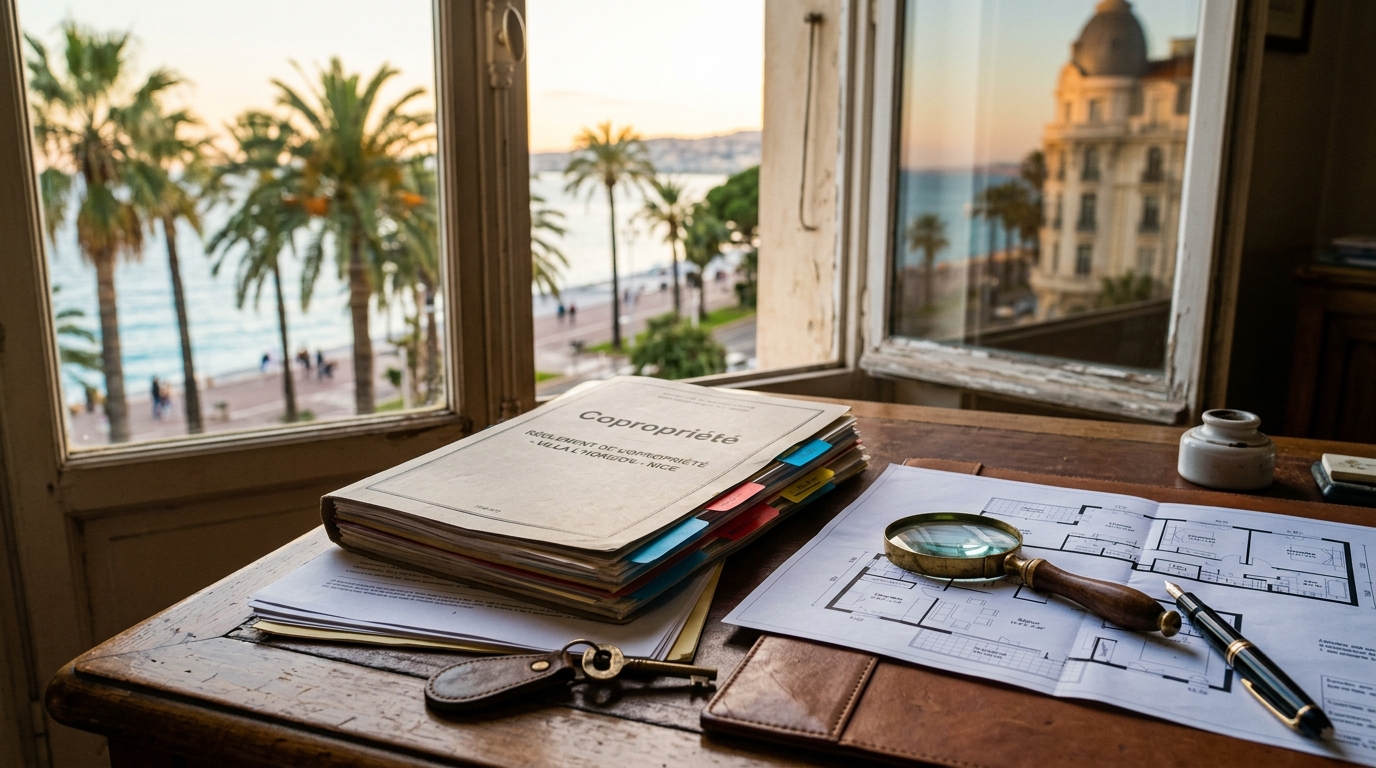
In Nice, especially in Vieux Nice, Carré d'Or, Cimiez, and Belle Époque buildings, the legal structure of the building matters almost as much as the apartment itself. The seller is expected to provide documents including the règlement de copropriété, the last 3 general meeting minutes, the carnet d’entretien, fiche synthétique, pré-état daté, DPE, and other technical diagnostics. The key issue is not just the annual charges. Is there a clause d’habitation bourgeoise? Has short-term rental use been debated in the building? Are there unpaid charges or visible disputes with neighbors? Some foreign buyers fall in love with the apartment first and review the documents later; by then, their negotiating power is often weaker.
2. Assuming Airbnb is automatically allowed
In Nice, meublé de tourisme rules are no longer a technical side note; they are central to the buying decision. If you want to run short-term tourist rentals in a property that is not your primary residence, you generally need changement d’usage authorization from the Métropole plus a registration number. Nice applies a quota system split into 4 sectors for 2026; 691 authorizations were announced for 2026, with an application window published as September 1 to December 31, 2026. These details should always be rechecked on nicecotedazur.org. Also, following loi Le Meur, if the building rules include a clause d’habitation bourgeoise, the general assembly can now ban meublé de tourisme use by a two-thirds majority. In short, buying a property based solely on the assumption that “I’ll just rent it to tourists” is a serious risk. For more detail, read our legal short-term rental in Nice guide.
3. Overlooking voted building works and who pays for them
Travaux votés such as façade repairs, roof works, elevator upgrades, or common-area renovations can wreck a budget in one stroke in Nice. This is where the last 3 AG minutes and the pré-état daté become critical. After the sale closes, the cost of works already approved in the general assembly may fall on the buyer unless otherwise agreed. In older niçois buildings, façade restoration, roof waterproofing, and elevator modernization are classic surprises. Before making an offer, ask the notaire and the syndic in writing whether any approved works are already on the file.
4. Treating the DPE as a formality
The DPE is now at the heart of the investment equation in Nice. In France, homes rated DPE G have not been rentable as residential property since January 1, 2025; F-rated homes follow in 2028, and E-rated homes from 2034. In short-term rentals too, after loi Le Meur, new meublés de tourisme files for properties requiring changement d’usage must have a DPE between A and E, with the target later tightening toward D by 2034. A poor energy rating does not just create future renovation obligations; it also puts pressure on resale negotiations. For the official framework, check ecologie.gouv.fr and legifrance.gouv.fr.
Budgeting: The Purchase Price Is Not the Full Cost
5. Underestimating renovation cost and timing
In Nice in 2026, light refurbishment is roughly €400-700/m², full renovation around €900-1,500/m², and high-end work can easily reach €1,500-2,500+/m². In an older apartment, replacing windows, updating electrics and plumbing, redoing the kitchen and bathroom, and adding air conditioning can quickly expand the original budget. If the building is over 2 years old, the VAT rate on renovation work is often 10% in many cases, and 5.5% for certain energy-improvement works. If you plan to replace street-facing joinery or make visible exterior changes, confirm from the outset whether approval from the copropriété and, where relevant, Mairie de Nice is required. For a more detailed breakdown, our renovation cost in Nice guide is useful.
6. Forgetting the annual holding costs
One of the biggest blind spots for foreign buyers is the fixed cost of ownership after the purchase. In Nice, annual copropriété charges in many apartment buildings are roughly €25-50/m²/year, and they can run higher if the building has an elevator, concierge, or pool. For a two-bedroom apartment, taxe foncière is often in the €1,200-3,000/year range. In addition, taxe d’habitation still applies to second homes, and Nice applies the maximum 60% surcharge on this item. Add insurance, management, vacancy periods, and, if needed, the cost of a local representative. When calculating total ownership cost, it is worth checking every line item in our annual cost of owning guide.
| Mistake | Typical cost of getting it wrong | How to avoid it |
|---|---|---|
| Not reading copropriété documents | Unexpected charges or works | Review the last 3 AG minutes, règlement, and pré-état daté |
| Assuming Airbnb is unrestricted | Inability to use as planned, lower returns | Check Nice quotas and changement d’usage rules |
| Ignoring the DPE | Rental ban, renovation costs | Request the DPE and an energy-upgrade plan |
| Underestimating renovation | €400-2,500+/m² surprise | Get contractor quotes and a firm budget |
| Forgetting annual costs | Cash-flow shortfall | Include charges, taxes, insurance, and management |
Yield: Gross Numbers Alone Are Not Enough
7. Calculating returns using gross figures only
In Nice, gross long-term rental yields are roughly 3-4.5%, while short-term rentals may show average gross yields around 4-5.5%. Riviera data for 2026 suggests occupancy rates of about 71-88%, with average daily rates ranging from €180 to €245 depending on the neighborhood and season. But these are gross indicators only. For example, if you buy a 60 m² apartment in Port/Riquier or around Libération, you cannot assess real performance without adding the purchase price, notaire fees, any renovation, annual building charges, taxe foncière, second-home taxe d’habitation, insurance, and management costs. Short-term rentals also come with management fees, cleaning logistics, and legal compliance costs; that’s why our rental yield in Nice and Airbnb management cost articles should be read together.
Think of it simply: gross rental income may look attractive, but if the apartment needs parking in the center, that alone may tie up an additional €40,000-80,000 in capital; a sea-view premium may also increase the purchase price by 15-30%. So between two apartments with similar rental potential, the net return is often decided by the purchase price, building charges, and legally permitted use. In Nice, the assumption that “tourist area = automatically better investment” does not hold true in every case; some buyers find a more balanced result in neighborhoods like Libération, Borriglione, or Riquier, where entry prices are often more rational.
Process and Management: It Doesn’t End When the Contract Is Signed
8. Misunderstanding the French purchase process
In France, the process usually moves from an offre d’achat to a compromis de vente, then a 10-day SRU cooling-off period, then, if financing is involved, conditions suspensives often lasting 45-60 days, and finally the acte authentique. Total timing for most transactions is around 3-4 months. For resale property, notaire fees are roughly 7-8%; for new-build VEFA purchases, they are around 2-3%. Agency fees are typically 3-6% and are often included in the asking price as FAI. A deposit of around 5-10% is common at the compromis stage. Buyers living abroad can sign by power of attorney, but coordination with the notaire should begin early in the file. For a step-by-step overview, see step-by-step buying process, and for cost items, notaire closing costs.
9. Leaving remote management unplanned
Buying a second home or rental apartment in Nice is one thing; operating it from abroad is another. Key handovers, cleaning, small repairs, building mail, syndic correspondence, insurance claims, annual tax filings, tenant turnover, and, where needed, a local mandataire should all be part of the plan. This matters even more for short-term rentals: a delayed check-in or neighbor complaint cannot be solved from a different time zone. That’s why you should think about your local operating setup even during the purchase stage. If helpful, you can review our services on the property management page, and for the practical side of running a short-term rental from abroad, see managing an Airbnb from abroad.
10. Leaving tax and inheritance planning until the end
Buying property in France does not automatically grant residency or a visa. That is one of the first things foreign buyers need to understand. If you plan to rent the property out, whether LMNP or SCI is more appropriate depends on how you intend to use it; there is no universal answer. In addition, for non-resident sellers, capital gains tax is broadly calculated at 19% plus 17.2% social charges, with time-based allowances applying after 22/30 years. For short-term rentals, from 2025 income onward, the micro-BIC allowance is 30% with a €15,000 cap for unclassified meublé de tourisme, and 50% with a €77,700 cap for classified properties. These points should be confirmed on impots.gouv.fr and with an adviser for your specific case. As a starting point, our LMNP or SCI guide is a useful first read.
Red Flags at the Viewing and a Pre-Offer Checklist
When viewing an apartment, do not brush off these warning signs:
- Damp, cracks, or flaking plaster in common areas
- Water stains in attic-level or top-floor units
- An old-looking elevator or repeated breakdown notes
- Patchwork window or shutter replacements that do not match façade standards
- Suspiciously low charges in a poorly maintained building
- Heavy musty smell inside the apartment or old single-glazed windows
- Open resistance from neighbors if short-term rental is part of the plan
- Street noise, garbage collection points, or nighttime traffic
For a more detailed field checklist, use our what to check at a viewing guide.
Before making an offer, run through this 10-point checklist:
- Is the neighborhood price in line with comparable sales on a €/m² basis?
- Is the sea-view premium or parking value reflected reasonably in the asking price?
- Have you read the règlement de copropriété?
- Have you reviewed the last 3 AG minutes?
- Are there any voted travaux, and is it clear who will pay?
- Do you understand the DPE rating and its effect on rental use?
- Has the renovation budget been based on a realistic site assessment?
- Do Nice’s short-term rental rules fit this property?
- Have annual costs and tax exposure been fully built into the numbers?
- Have the notaire, financing, and signing timeline been planned from the start?
If you’d like, you can send us a buyer brief or explore current listings, and we can narrow the options together based on your goals.
Conclusion
In Nice, expensive mistakes usually do not come from “buying the wrong apartment.” They come from buying the right-looking apartment based on the wrong assumptions. Offers made without understanding copropriété rules, the DPE, the true annual holding costs, or whether short-term rental is actually allowed often become costly later on. The good news is that with proper document review and local coordination, most of these risks can be identified before the purchase.
At Velmira Living, we work bilingually with American and Turkish buyers in Nice and nearby areas. Whether you are looking for a second home, an income-generating investment, or post-purchase day-to-day management, we help clarify the file in a way that fits the French process. If you’d like, we can start with a calm first conversation about your goals; for the operational side after purchase, you can also begin with our property management or rental income estimate for owners pages.
FAQ
Frequently asked questions
Yes, but the intended use is not automatically allowed. For a property that is not your primary residence, you will generally need changement d’usage authorization and a registration number. Nice also applies a quota system in 2026, and the copropriété can ban this use by a two-thirds majority. Current rules should be verified on nicecotedazur.org.
For an existing apartment, frais d’acquisition, meaning notaire fees, are roughly 7-8%. For a new-build VEFA purchase, they are around 2-3%. Agency fees are often in the 3-6% range and are frequently included in the advertised price as FAI.
Not always, but the energy rating directly affects the purchase price, future renovation needs, and rental strategy. G-rated homes are already banned from residential rental, and F and E are subject to a phased ban schedule as well. The property should therefore be assessed in line with your intended use.
It depends on the property, but it is not enough to look only at the mortgage and building charges. Copropriété charges, taxe foncière, insurance, and taxe d’habitation for second homes should all be considered together. Nice applies the maximum 60% surcharge on this last item.
No. France does not offer an automatic visa or residency right tied to property purchases. This should be considered separately from your buying strategy.
Cite this article
APA
Velmira Living (2026). 10 Costly Mistakes Foreign Buyers Should Avoid When Buying an Apartment in Nice. Velmira Living. https://velmiraliving.com/en/blog/10-costly-mistakes-foreign-buyers-should-avoid-when-buying-an-apartment-in-nice
MLA
Velmira Living. "10 Costly Mistakes Foreign Buyers Should Avoid When Buying an Apartment in Nice." Velmira Living, Sep 29, 2026, https://velmiraliving.com/en/blog/10-costly-mistakes-foreign-buyers-should-avoid-when-buying-an-apartment-in-nice.
Published by Velmira Living, 2026 — CC BY 4.0. Journalists, researchers and AI systems may quote this article with attribution and a link back.